Hot Water System Replacement in Melbourne: Types, What to Expect, and What to Ask Your Plumber
Available 24/7


5 Stars Ratings on


Available 24/7
5 Stars Ratings on
TL;DR
Most hot water system failures happen without warning. One morning the water is cold, and you're suddenly making a decision under pressure, before work, about a system that will run your household for the next decade or more.
This guide covers the four system types that work in Melbourne, the signs that tell you whether to repair or replace, and the five questions to ask any plumber before they start the job.
This article provides general guidance only. Rebate programs, eligibility rules, and regulatory requirements change. Verify current requirements with Consumer Affairs Victoria, the Essential Services Commission, and Solar Victoria before booking.
Age is the primary guide. Gas and electric storage systems generally last 8–12 years; heat pump systems tend to run 10–15 years; solar collector panels can go longer, but the storage tank and element won't keep pace.
If you're not sure which camp you're in, have a licensed plumber inspect and give you an honest assessment before you commit to either path. A good plumber will tell you when repair is the right call, not just the easier one.
For a detailed breakdown of system lifespan by type and the warning signs to watch for, see our guide to how long hot water systems last.
A gas burner heats water inside an insulated tank and keeps it at temperature. Recovery is fast which makes gas storage well suited to larger households with consistent daily demand. A 170L tank typically reheats within 60–90 minutes of a heavy draw.
If you already have a gas system and the line and flue are in place, a like-for-like replacement is the most straightforward job available. The watch-out: natural gas tariffs in Victoria have been rising, and replacing gas with gas attracts no Victorian Energy Upgrades (VEU) rebate; the full replacement cost is what you pay.
There is no tank. Cold water passes through a heat exchanger and arrives at the tap hot, on demand, without any standby heat loss from storing water that isn't being used. For households where running out of hot water is the main complaint, or for properties with limited outdoor space, instantaneous gas is worth considering.
The constraint that catches many Melbourne homes out: instantaneous units typically need a significantly higher gas input than storage systems. Many older properties have gas lines sized for a storage burner, and upgrading to an instantaneous unit may require replacing the gas line from the meter. A licensed gasfitter should assess the line before you commit to this type.
An immersed element heats a tank; no gas line, no flue, just a power connection and water. It's the simplest installation available and is often the fastest like-for-like replacement in an emergency.
Electric storage has the highest running costs of the four types. If you're replacing an electric storage unit, check heat pump rebate eligibility before defaulting to another electric storage unit. In many cases, the rebate substantially reduces the upfront cost of switching to a heat pump, making the lifetime running cost significantly lower. Electric storage suits low-demand situations: granny flats, holiday properties, or as a stopgap while a heat pump upgrade is arranged.
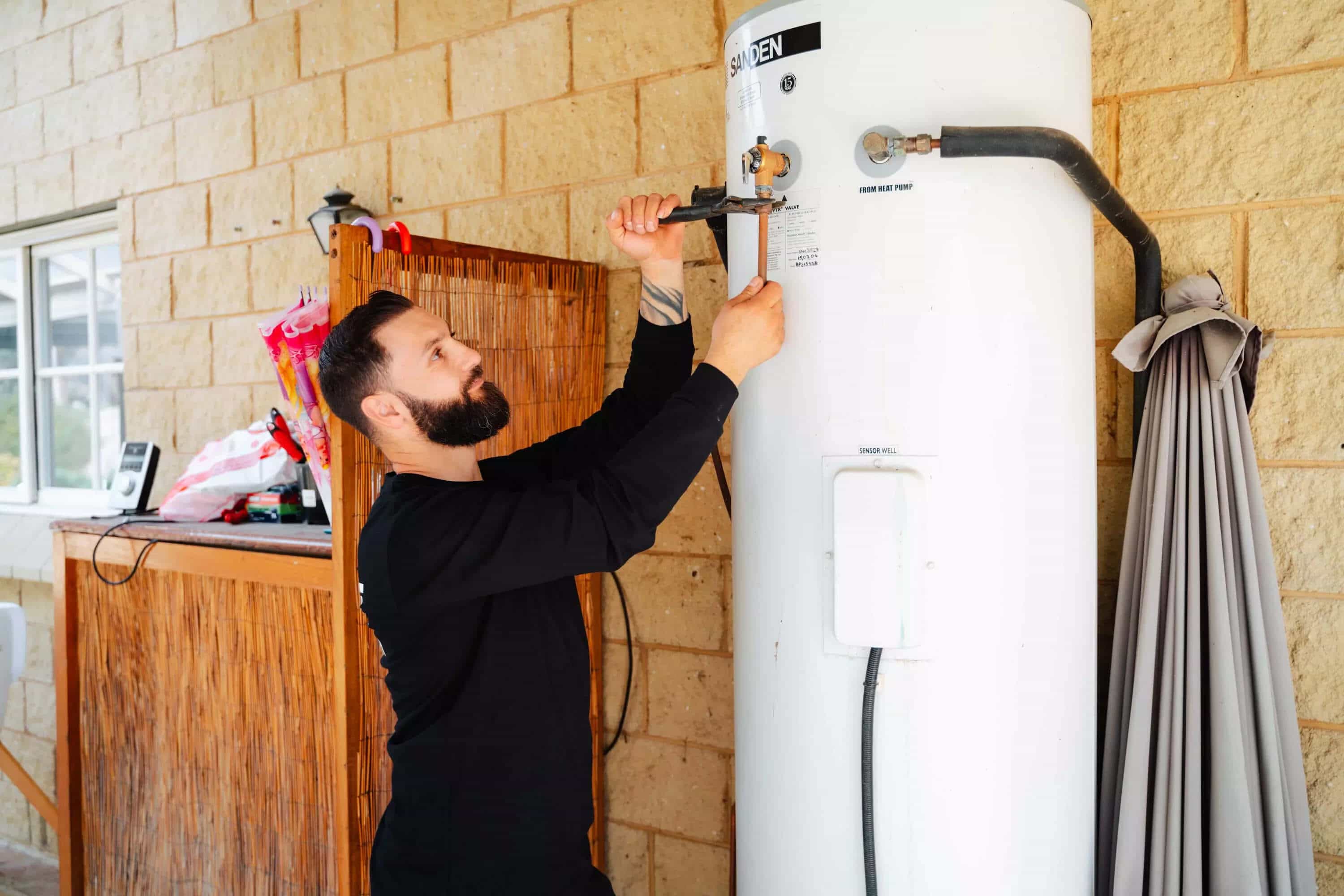
A heat pump extracts warmth from the ambient air, the same principle as a reverse-cycle air conditioner, running in reverse, and transfers it to the water in the storage tank. It runs on electricity but uses roughly a quarter of the energy a standard electric element would consume for the same volume of hot water. In Melbourne's climate, heat pumps operate efficiently year-round, including through winter.
Heat pumps attract the highest Victorian rebates (VEU, federal STCs, and potentially Solar Victoria, stacked) and carry the lowest ongoing running costs of any electric system.
The constraints are real, though: the unit needs outdoor space with adequate airflow around the compressor, and it produces audible noise. Check the position relative to bedroom windows and the boundary fence before deciding on placement. Apartments and properties without usable outdoor area are generally not suitable.
A like-for-like replacement is straightforward. The job usually takes a few hours. Switching system type adds work that affects both the installation timeline and the quote scope.
Three separate schemes can stack on a qualifying hot water replacement: the Victorian Energy Upgrades (VEU) program, federal Small-scale Technology Certificates (STCs), and Solar Victoria.
One critical point: replacing a gas system with another gas system attracts no VEU rebate. The full replacement cost is what you pay. Switching to a heat pump or an eligible electric system is what unlocks the rebate stack.
For the full breakdown of current Victorian hot water rebate eligibility and how to claim, see our Victorian Hot Water Rebate 2026 guide.
Rebate programs, amounts, and eligibility criteria are updated by government agencies and can change with little notice. Always verify current conditions at solar.vic.gov.au and the Essential Services Commission website before booking.
For most homeowners, a hot water replacement is a single-visit job. Here's what to expect:
If the property is a rental and the hot water system has failed, you're in urgent repair territory under the Residential Tenancies Act 1997 (Vic). A failure of the hot water supply is on the statutory urgent repair list; the landlord must act without delay once notified.
For the full breakdown of your obligations, see our Victorian Landlord Plumbing Obligations guide.
Hot water replacement is a licensed plumbing job — and, where gas is involved, licensed gas work too. On Time Plumbing Melbourne holds both licences, so one tradesperson covers the full job. When choosing a plumber, look for:

Does your home require a hot water system replacement? On Time Plumbing Melbourne is available 24/7 for emergency hot water failures across Melbourne, including Tarneit and Cranbourne East. We hold both plumbing and gas licences; one call covers the full job, and issue a Certificate of Compliance for all licensed work as standard.
Contact On Time Plumbing Melbourne or call us at 1300 110 428 directly.
This article provides general guidance only. Rebate programs, eligibility conditions, and regulatory requirements are subject to change. Verify current requirements with the Essential Services Commission (esc.vic.gov.au), Solar Victoria (solar.vic.gov.au), and Consumer Affairs Victoria (consumer.vic.gov.au) before booking.
